
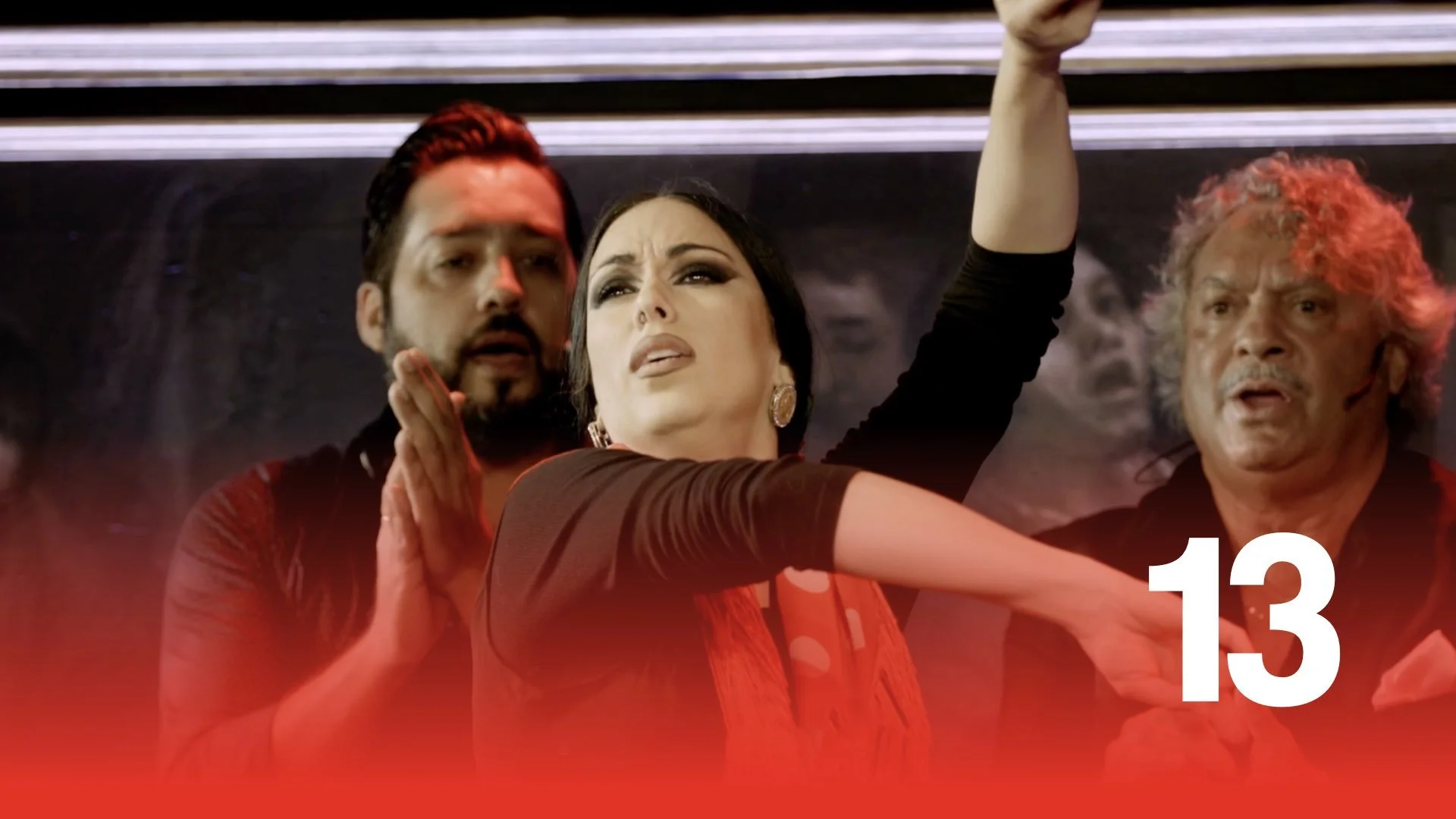
FLAMENCOPEDIA | EPISODE 13
Long live the show
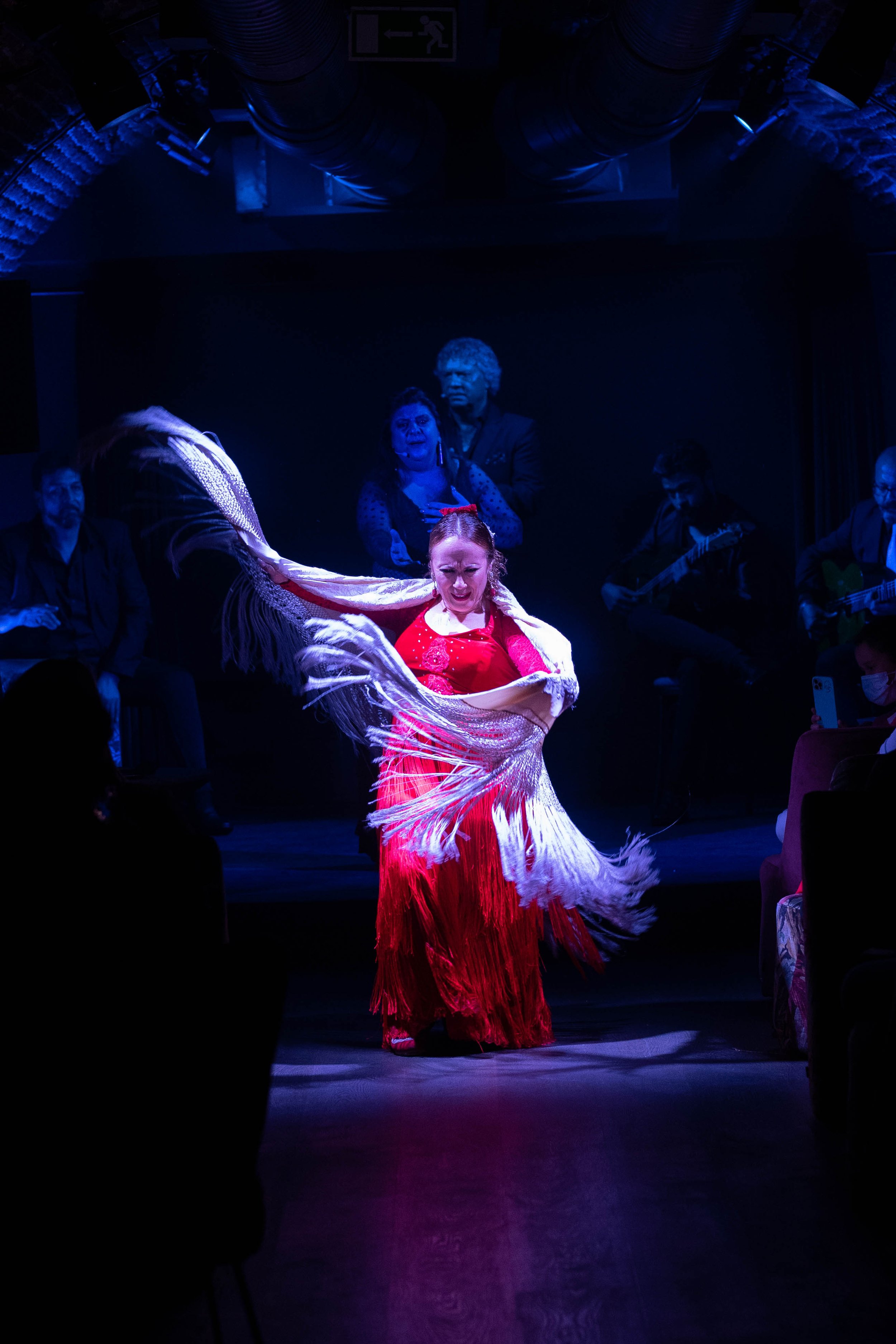
Singing, guitar, dance, and percussion come together every night on the stage of a tablao. Historically, the term “cuadro flamenco” refers to a group of artists who perform together and share a set of conventions that allow them to combine structure, improvisation, and moments of individual spotlight.
The show has a set duration and program, but it is not completely fixed. The cast may change, guests or special performances may be added, and each performance may be different. That ability to create on the spot is one of the essential characteristics of the flamenco tablao.
Singing, guitar, and dancing on stage
There is no single formula for putting together a flamenco show. Pedro Córdoba, from the Centro Cultural Flamenco de Madrid, believes that a well-rounded show must showcase different dimensions of this art form. Javier Andrade, from Teatro Flamenco Madrid, lists segments featuring singing, guitar, and dance, as well as solo and group performances, culminating in the finale. The spotlight thus shifts from one performer to another, with a particular emphasis on dance. Each artist knows their role but must also be attentive to what the others are doing. The show is built on that communication.
Improvisation requires years of preparation
The freedom of the tablao does not mean a lack of preparation. Belén López draws a distinction between it and a theatrical performance, where everything may be rehearsed and carefully planned in advance. In the tablao, there is much greater room for what happens in the moment. Ana Romero sums it up succinctly: “We don’t rehearse.” The artists arrive having already done their work, and it is precisely that knowledge that allows them to improvise freely.
Pedro Córdoba emphasizes the years of preparation needed to reach that level. The rhythm and shared codes provide the structure within which the artists can respond to one another. The show is “cooked up” this way every night: they know the language, but not exactly what the result will be.
The Intimacy of the Tablao
Every tablao has its own personality, but one of the common characteristics of the flamenco tablaos in Madrid is the closeness between the performers and the audience. From just a few meters away, you can sense the dancer’s effort, the singer’s breath, the guitarist’s hands, and the glances exchanged between the performers. Armando del Rey, from the Corral de la Morería, describes flamenco’s ability to reach the audience as something that “cuts right through your chest” and stirs you from within. For Marisol Navarro, of Tablao Flamenco Las Tablas, moreover, it’s not necessary to have any prior knowledge of flamenco. All you need to do is approach the performance with an open heart and let the artists convey their art.
Technique in the Service of Emotion
Juan Manuel del Rey, from Corral de la Morería, sums up flamenco through three concepts: excellence, art, and emotion. Technique is essential, but it is not the goal in and of itself. For Belén López, the best artist isn’t necessarily the one with the most technical skill, but rather the one who manages to evoke an emotion, awaken a memory, or move the audience. Javier Andrade highlights precisely the reactions of people with no prior knowledge who leave the performance convinced they’ve experienced something special. And Juan Andrés Maya, from Tablao La Carmela, points out that the artist does not dance solely for himself: he has an audience in front of him that he must win over.
That is where much of the tablao’s uniqueness lies. The performers bring years of experience to the stage, share a common framework, and create live, just a few meters from the audience. That is why a show can be performed every night without ever being exactly the same.
Flamencopedia: Discover All the Episodes
"Flamencopedia " is a 15-episode series that explores flamenco through its key figures.
Episode 1: Discovering Flamenco
Episode 2: Madrid, the Capital of Flamenco
Episode 11: The Guitar and Guitar Makers
Episode 12: The Rhythm and the Commotion
Episode 13: Long Live the Show
You might be interested in…

Experience Flamenco at Madrid's Tablaos
Consult the program
for flamenco shows in our tablaos.

Discover Madrid's World Heritage Sites
Visit the Community of Madrid